by Richard William Nelson | Sep 7, 2024
 Selection is the third of the five principles of natural selection introduced by Charles Darwin in The Origin of Species. Darwin wrote –
“Over all these causes of Change, I am convinced that the accumulative action of Selection, whether applied methodically and more quickly, or unconsciously and more slowly, but more efficiently, is by far the predominant Power.”
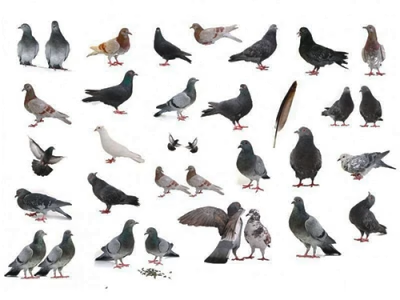
To explain selection, Darwin drew a parallel between a breeder’s selection process and natural selection, using pigeon breeding (pictured above) as one example. At the time, breeding pigeons was a prestigious pastime for the elite.
Continue Reading
by Richard William Nelson | Jan 3, 2023
 The modern genetic shift early in the twentieth century rescued Darwin’s theory of natural selection, to a point. By the end of the nineteenth century, Charles Darwin’s influence had continued to deteriorate, stemming from his obsolete theory of inheritance.
In the search for a scientifically valid theory, scientists early in the twentieth century rediscovered Gregor Mendel’s theory of inheritance. His work had been published thirty years earlier.
Mendel’s theory delivered what Darwin missed – a scientifically valid theory of inheritance capable of driving evolution.
Continue Reading
by Richard William Nelson | Nov 8, 2022
Inheritance is the second of the five principles of natural selection introduced by Charles Darwin in The Origin of Species. While Darwin knew that inheritance plays a crucial role in natural selection, he was conflicted over how it works, noting –
“The laws governing inheritance are, for the most part, unknown.”
Niles Eldredge, of the American Museum of Natural History, introduced the V.I.S.T.A. framework to codify the principles of Darwin’s theory. The five structural principles of natural selection are variation, inheritance, selection, time, and adaptation.
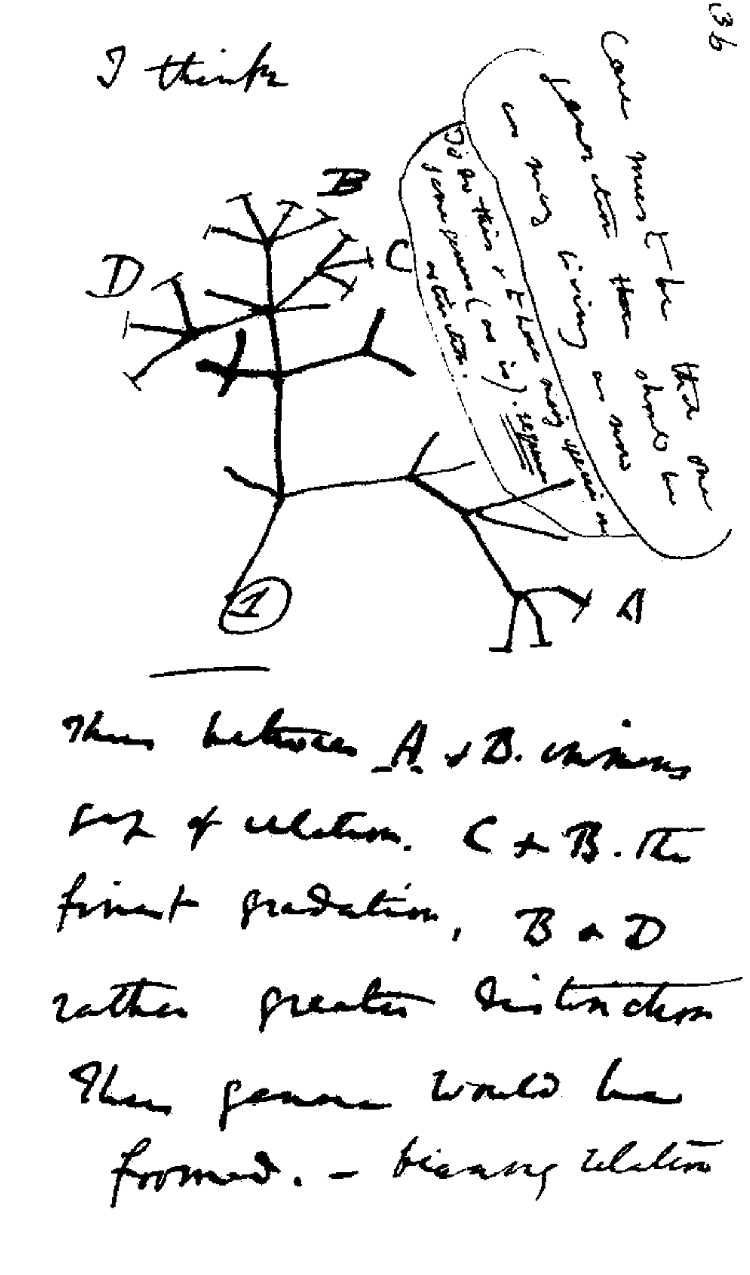
In 1837, nearly twenty years before publishing The Origin of Species, Darwin drew his first sketch linking inheritance to speciation (pictured left).
Continue Reading
by Richard William Nelson | Aug 17, 2022
Variation is the first of the five principles of natural selection introduced by Charles Darwin in The Origin of Species. Darwin explains –
“Natural Selection acts exclusively by the preservation and accumulation of variations,”
Niles Eldredge, of the American Museum of Natural History, introduced the V.I.S.T.A. framework to codify the principles of Darwin’s theory. Darwin’s five structural principles of natural selection are variation, inheritance, selection, time, and adaptation.
Continue Reading
by Richard William Nelson | May 27, 2022
Logic and science play crucial roles in understanding how nature works. Importantly, however, there are distinct types of logic and methods in science. Selecting the appropriate type of logic and science is crucial for developing scientifically valid explanations.
Charles Darwin applied various logic and scientific methods in his life-long quest to explain how Earth’s biosphere works. The story of his quest is fascinating, giving insight into how the interplay of logic and science still influences modern evolution research.
Continue Reading

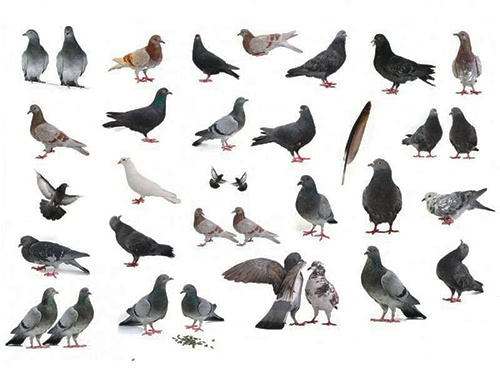 Selection is the third of the five principles of natural selection introduced by Charles Darwin in The Origin of Species. Darwin wrote –
 The modern genetic shift early in the twentieth century rescued Darwin’s theory of