Posts Tagged ‘evolution’

“Mad Dream” Challenged by Pasteur


Charles Darwin, desperate to discover how evolution keeps going, in 1865, sent his good friend, Thomas Huxley, a thirty-page manuscript under the heading “The Hypothesis of Pangenesis.” Huxley’s response must have been discouraging, since Darwin replied, “I do not doubt your judgment is perfectly just and I will persuade myself not to publish. The whole affair is much too speculative.”

Pangenesis extended Aristotle’s concept of “spontaneous generation,” later popularized by French naturalist Jean-Baptiste Lamarck. Still anxious, two years late in 1867 Darwin sent a letter to American scientist, Asa Gray at Harvard University -

The chapter on what I call Pangenesis will be called a mad dream, and I shall be pretty well satisfied if you think it a dream worth publishing; but at the bottom of my own mind I think it contains a great truth.

Continue Reading

Beyond the Bounds


Contrary to popular opinion, The Origin of Species was not a scientific work, and Charles Darwin makes that point very clear –

I am quite conscious that my speculations run quite beyond the bounds of true science.

Rather, Darwin called The Origin of Species “one long argument”—not a scientific showcase. Darwin makes this point because he knew what differentiates science from logic.

More than 200 years before the publication of The Origin of Species, English scientist Francis Bacon formalized what is now known as the Scientific Method – the only proven method of scientific inquiry for discovering natural laws.

As a founding member of the Royal Society, Bacon was quoted by Darwin in the preamble of The Origin of Species. The Scientific Method had earlier been used by Copernicus and Galileo overturning the geocentric worldview, and later by Isaac Newton that lead to the discovery of the natural laws of motion and gravity. Continue Reading

Genetics to Epigenetics, the Third Wave


In his autobiography, Charles Darwin notes, “Towards the end of the work I gave my well abused hypothesis of Pangenesis. An unverified hypothesis is of little or no value”—the First-Wave of evolutionary thought. Today, Darwin’s sentiments on pangenesis have re-emerged, however, this time on genetics.

In this week’s edition of the journal Science published by the American Association for the Advancement of Science (AAAS), the focus is on epigenetics. An on-line issue even features a video by Science editor Guy Riddihough asking a number of top researchers a simple question: “What’s your definition of epigenetics?” And, “Their answers aren’t quite so simple,” according to Riddihough. Continue Reading

Nature, the Journal Explains


Charles Darwin simply presented an argument in The Origin of Species for evolution. Darwin called it “one long argument”.

Even critical of his own work, in a letter to H. Falconer in October 1862, Darwin wrote, “I look at it as absolutely certain that very much in the Origin will be proved to be rubbish; but I expect and hope that the framework will stand.”

To demonstrate that Darwin’s framework has stood the test of time, in 2008 the journal Nature, launched the following challenge to evolutionists – “Evolution is a scientific fact, and every organization whose research depends on it should explain why… Between now and the 200th anniversary of Charles Darwin’s birth on 12 February 2009, every science academy and society with a stake in the credibility of evolution should summarize evidence for it on their website and take every opportunity to promote it.”

Continue Reading

Value


Charles Darwin lamented in his autobiography over ascribing to pangenesis in The Origin of Species

Towards the end of the work I gave my well abused hypothesis of Pangenesis. An unverified hypothesis is of little or no value.

While Darwin’s hypothetic pangenesis was an accepted theory in 1859, by 1864 French biologist, Louis Pasteur, had undermined pangenesis by demonstrating that life cannot arise spontaneously—life can only come from life. Darwin was right. Pangenesis is of “no value.”

By the mid-twentieth century, while Francis Crick and James D. Watson unveiled the molecular structure of DNA. In 1953, the momentum of evolution theory was rapidly defaulting to a mutation plus natural selection neo-Darwinian model, most commonly known as Modern Synthesis.
Continue reading

Battle of the Architects


The essence of Charles Darwin’s theory, natural selection, is reflected in the title of his book—The Origin of Species by Means of Natural Selection. Natural selection, Darwin argued, is the architect of evolution, “As square stone, or bricks, or timber, are the indispensable materials for a building, and influence its character, so is variability not only indispensible but influential. Yet in the same manner as the architect is all important person in a building, so is [natural] selection with organic bodies.”

Charles Lyell and Asa Gray, Darwin’s closest confidants, solidly disagreed. Lyell argued that natural selection can only preserve or eliminate; natural selection cannot create: “The destroy[ing] force is selection, the sustaining [force] preserves things … but in order that life shd. Exist where there was none before… this is not [natural] selection, but creation.”

Continue reading

Altenberg-16, the Third Wave


Even Darwin knew that the arguments in The Origin of Species would not stand the test of time. Critical of his own work, in a letter to H. Falconer in October 1862, Darwin wrote, 

I look at it as absolutely certain that very much in the Origin will be proved to be rubbish; but I expect and hope that the framework will stand.

By the end of the nineteenth century following the failure of the HMS Challenger mission to discover the theoretical “innumerable” missing links and evidence in The Origin of Species was acknowledged as fraudulent, Darwin’s theory was emerging as scrap yard re-cycling material.

“Things did not look any better for the Darwinian view of evolution at the onset of the twentieth century, when the re-discovery of Gregor Mendel’s work and the beginnings of genetics appeared to deal a blow the theory,” writes Massimo Pigliucci in his new book entitled Evolution-The Extended Synthesis published by MIT Press.

Not only was the fossil record not cooperating, Mendel’s work patently contradicted Darwin’s central premise of inheritance through “gemmules”, “blending”, and Lamarckism. Mendel demonstrated that inheritance occurs through discrete units; evidence that excludes Darwin’s “slight, successive” changes. The evidence signaled the end of the First Wave of evolutionary thought. Continue reading

The Mystery of Cat and Fly Species


Within On the Origin of Species by Means of Natural Selection, or the Preservation of the Favoured Races in the Struggle for Life are actually two titles—separated by “or”.

In the text of the book, “species” is the most commonly word used from the title—1,926 times. From the words in the title, the next most commonly used word from the title is “natural”, appearing just 764 times.

Therefore, in the 3,878 sentences of first edition, nearly 50% of the sentences include the term “species.” The concept of “species” is central. Ironically, however, Charles Darwin never defines the term “species”. In fact, Darwin explains that “species” defies definition:

No certain criterion can possibly be given by which variable forms, local forms, sub species, and representative species can be recognized.

After 150 years of unprecedented research, the concept of species continues to defy definition. Technological advances in the mid-twentieth century were expected to discover the molecular basis of species. However, rather than solving the mystery, technology has only re-enforced the mystery.

“If we want to solve the problem underlying every origin of species in molecular terms,” Italian geneticist Giuseppe Sermonti explains in his book entitled Why a Horse is Not a Fly, “we have to admit that for the moment the answer is not forthcoming. And there is no answer.”

A natural explanation for the mystery of species continues to elude a scientific explanation. What we know is what we have always known. A cub is born a cub because its mother was a she-cat that mated with a tom. The fly emerged as a fly larva from a fly egg. Kind follows kind. Who knows why?

Through decades of studying tens of thousands amino acids, nucleic acids, proteins, DNA, RNA, and genetic codes, the deciphering any molecular hieroglyphic evidence to define a species continues to elude scientists. This issue is what is called the “species problem.”

Continue reading

Westminster Review

Charles Darwin’s notoriety long preceded the publication of The Origin of Species by Means of Natural Selection in November 1859. The Darwin family legacy has been likened to the Kennedy legacy in the twentieth century.

The Darwin legacy sold the book. No publicity was needed. All 1,250 printed copies were sold on the first day. The Origin of Species by Means of Natural Selection was an immediate success, the Harry Potter of the nineteenth century, and sequel to the widely popular Vestiges of the Natural History of Creation.

In the afternoons, Prince Albert was known for reading Vestiges aloud to Queen Victoria. The English writer of Vestiges, Robert Chambers (1802–1871) goal was to inspire popular interest in evolution—a Discovery Channel forerunner.

Darwin, however, received wide spread of publicity, with the Westminster Review leading the publicity campaign. In 1851, Chambers aligned with the widely popular Westminster Review journal that had been established in 1823 by British philosopher and economist Jeremy Bentham and James Mill as the official arm of the Philosophical Radicals. The Westminster Review was a the New Yorker prototype. Continue reading more

Butterfly Nightmare


Jerry Coyne, in his new book entitled Why Evolution is True, conveniently circumvents any reference to the butterfly, as does Darwin-Discovering the Tree of Life by Niles Eldridge. The California State sponsored website, “Understanding Evolution,” website completely ignores the notorious nature of butterflies—metamorphosis.

So, why is the evolution industry silent on butterfly metamorphosis? The answer is simple—the same DNA is found in all four life cycles; egg, caterpillar (larva), cocoon (pupa) and butterfly (adult). Metamorphosis, to the theory of evolution, is an enigma.

For over 3,500 years, to the Egyptians, Chinese, and Greeks, the butterfly symbolism was derived from the unique butterfly life cycles. The egg first develops into the caterpillar before transitioning into the cocoon. Amazingly, inside the cocoon, the caterpillar is destroyed before developing into the stunningly colorful butterfly cycle. Continue reading more


Buy Now

Kindle Edition Available


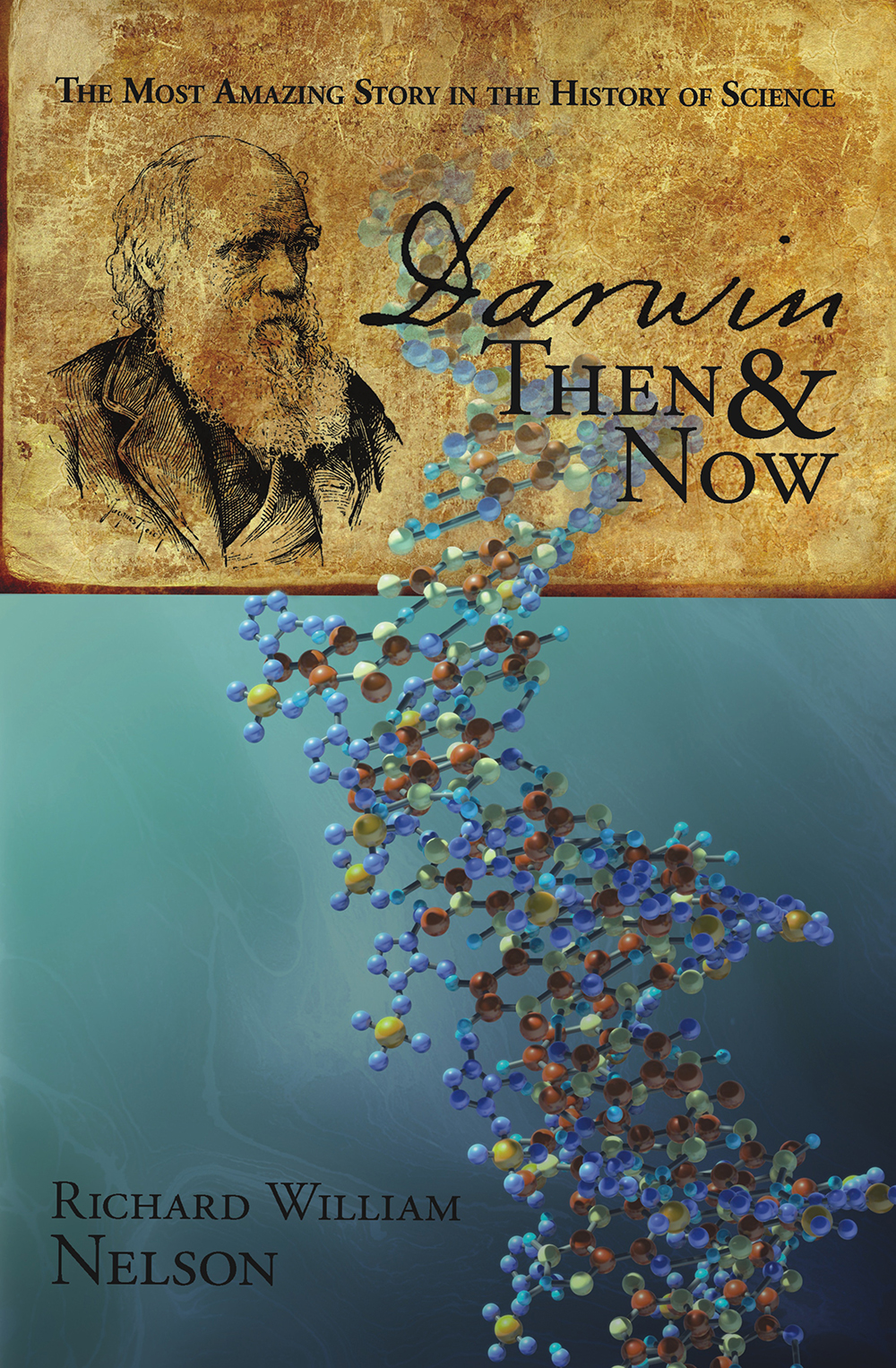
A SCIENCE WAR is raging over the scientific evidence. Discover the history behind the rise and fall of Darwinism during the past 150 years in this history of evolution narrative—with over 1,000 references quoting directly from scientists.

With Charles Darwin as the central main character, Darwin Then and Now defines how the accumulating scientific evidence continues to define the battle lines of this twenty-first century war.

Connect