by Richard William Nelson | Sep 7, 2024
 Selection is the third of the five principles of natural selection introduced by Charles Darwin in The Origin of Species. Darwin wrote –
“Over all these causes of Change, I am convinced that the accumulative action of Selection, whether applied methodically and more quickly, or unconsciously and more slowly, but more efficiently, is by far the predominant Power.”
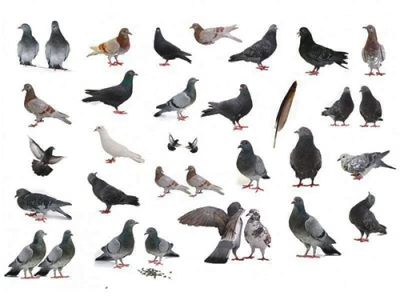
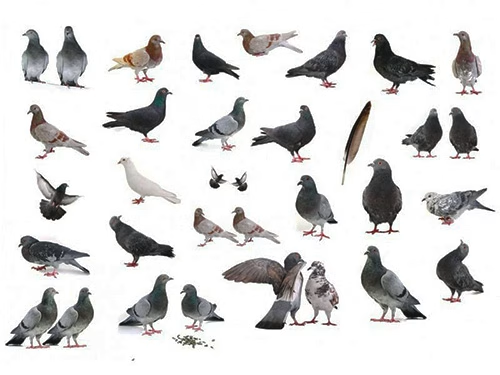
To explain selection, Darwin drew a parallel between a breeder’s selection process and natural selection, using pigeon breeding (pictured above) as one example. At the time, breeding pigeons was a prestigious pastime for the elite.
Continue Reading
by Richard William Nelson | Jul 13, 2023
 Concepts of biological evolution center on species, the central agent of evolution. This centrality is demonstrated in the title of Charles Darwin’s bestseller —
“On the Origin of Species by Means of Natural Selection”
One of modern biology’s principal functions includes the naming, grouping, and defining of species. However, exploring the history of the term opens a fascinating window into the checkered history of Darwin’s theory of natural selection.
Continue Reading
by Richard William Nelson | Aug 17, 2022
Variation is the first of the five principles of natural selection introduced by Charles Darwin in The Origin of Species. Darwin explains –
“Natural Selection acts exclusively by the preservation and accumulation of variations,”
Niles Eldredge, of the American Museum of Natural History, introduced the V.I.S.T.A. framework to codify the principles of Darwin’s theory. Darwin’s five structural principles of natural selection are variation, inheritance, selection, time, and adaptation.
Continue Reading
by Richard William Nelson | Jan 13, 2022
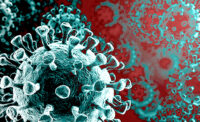
Three years into the pandemic, the origin of COVID-19 is still controversial. Two leading theories are under investigation: natural selection process or genetically engineered – each with vastly different implications. The phylogenetics of coronaviruses is the key to the COVID-19 origin dilemma and gaining insights into the theory of evolution.
Coronaviruses are RNA, not DNA viruses. RNA viruses are associated with causing the common cold, influenza, mumps, and measles; coronaviruses in humans can cause respiratory tract infections ranging from no symptoms, mild symptoms to a cytokine storm resulting in organ failure and death in humans.
Continue Reading
by Richard William Nelson | Mar 31, 2021
The platypus puzzles naturalists and scientists alike. While its bizarre characteristics seem to defy a natural explanation, the platypus may be a classic transitional link. Like a reptile, it lays eggs, yet, it nurses with milk without nipples. As one of the least understood living mammals, and unlike any other known species, it has ten sex chromosomes. The platypus produces venom, like a reptile, and uses electroreception, like a shark – a puzzle known as the platypus paradox dilemma.
That’s not all; the list of oddities goes on. To gain an understanding of this evolution icon, scientists have long-awaited insights from its genome. This January’s journal Nature reports on the most comprehensive investigation of the platypus genome ever performed.
Continue Reading

 Selection is the third of the five principles of natural selection introduced by Charles Darwin in The Origin of Species. Darwin wrote –
 Three years into the pandemic, the origin of